
Our commitment at PRONI is to provide access to our archives for everyone and ensuring our building is equipped with accessible facilities throughout. Plan ahead for your visit with our list of accessible features and our Accessibility Maps. If you have any problems or questions during your visit, our staff will be happy to help you.
Accessible facilities at PRONI
Building facilities
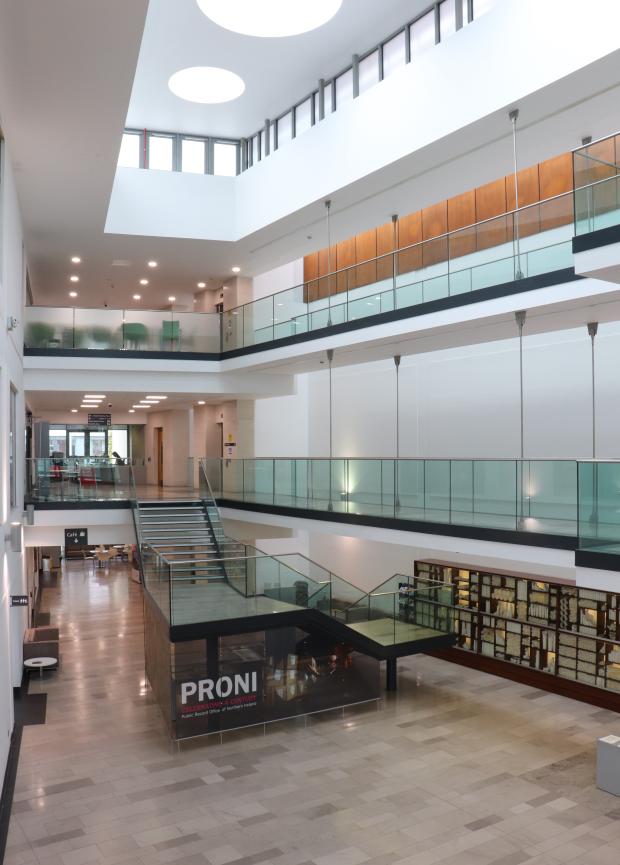
- An accessible ramp to the main entrance (left-hand side of the building)
- An accessible automatic door at the main entrance
- A wheelchair accessible lift between Ground Floor and First Floor (next to the stairwell
- A loop system for hearing aids at Reception, the Search Room Help Desk, the Issue Desk, and the Conference Room
- Information on records and services available in accessible formats from Reception (large print, audio, etc.)
- Evacuation chairs in emergency exit stairwells and staff trained to use them
- Guide and hearing dogs permitted throughout the building (please inform a member of staff if you have one with you)
Ground floor
- Wheelchair-accessible toilets opposite the PRONI Reception desk
- Moveable tables and chairs in the Heritage Café
Search Room
- Two height-adjustable tables
- Document ordering computer with large characters on the keyboard
- Magnifying glass available from the Help Desk
- Digital microfilm reader (near the Help Desk) with font enlargement and clarity features
Reading Room
- Two height-adjustable tables
- Magnifying glass available from the Issue Desk
PRONI is a large building, so if you have mobility difficulties you may also wish to bring someone to assist you. However, if you wish to access the Search Room or Reading Room, both you and your assistant will need to register/be registered as PRONI Readers. See our Registering as a Reader page for more information on this process and acceptable forms of identification.
Accessibility Maps

As part of our year of Celebrating Inclusivity and Diversity in the Archives in 2024/2025, we are pleased to have created Accessibility Maps of the PRONI building.
The document includes four maps in total – two general maps of the Ground Floor and First Floor and two detailed maps of the Search Room and Reading Room.
These interactive maps highlight our facilities and sensory features (such as lighting and noise levels) to help you plan your visit.
Explore the maps by hovering over (or tapping) the icons to see the location of facilities and sensory elements.